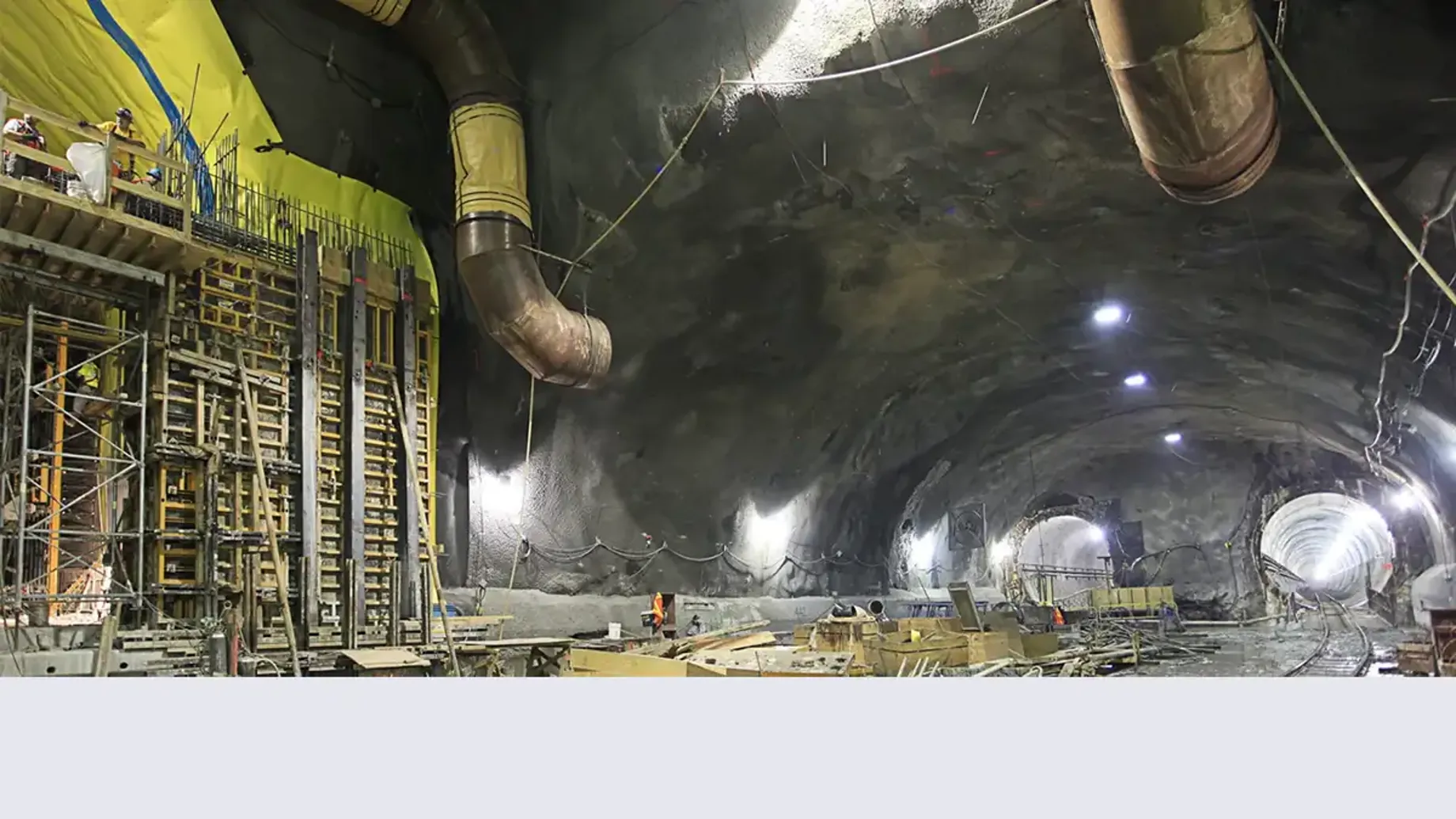
The Metropolitan Transportation Authority (MTA) needed to extend New York City’s No. 7 subway line to Manhattan’s far West Side, marking the city’s first subway track expansion in 25 years.
Arup contributed to the No 7 Line extension’s successful completion by enabling the ahead-of-schedule delivery. In particular, we played an integral role in resolving many of the rock support and construction sequencing challenges. Our scope included geotechnical engineering, tunnel design and structural engineering.
The extension helped unlock one of New York City’s most significant redevelopment areas by improving access to Manhattan’s far West Side. The project also advanced understanding of how large rock caverns can be designed and constructed safely in a dense urban environment. Completed in 2015, the extended No 7 line forms a vital part of one of the most significant redevelopment schemes in the city’s history. The project also provided a rare opportunity to design and construct large rock caverns in a dense urban environment.
Designing tunnels through complex ground conditions
Arup brought together geotechnical engineering and tunnel design to help extend the No 7 line through Midtown Manhattan, one of the world’s most challenging urban tunnelling environments. The project required careful management of low rock cover, the presence of variable surcharge conditions, sensitive iconic structures in close proximity to the excavations, and a general lack of recent mined cavern construction experience in New York City.
Working closely with contractors, we also developed safe, effective and efficient initial ground support designs for the geomechanically complex underground facilities using empirical, kinematic (rock block and wedge stability) and numerical methods. Our approach helped resolve rock support and construction sequencing challenges, supporting the excavation of large-span caverns through adaptable and buildable methods.
Engineering safe underground structures and junctions
Arup’s structural engineering work supported the design of underground structures and complex junctions along the tunnel alignment. Constructing the numerous junctions required throughout the tunnel’s length was among the more complicated technical challenges of the project. We created an innovative information-gathering and analysis process to determine how much additional reinforcement would be required around each junction. The process has since been applied in several other large-scan caverns around the world.