
Designing and engineering the Netherlands’ tallest timber-hybrid residential building
HAUT
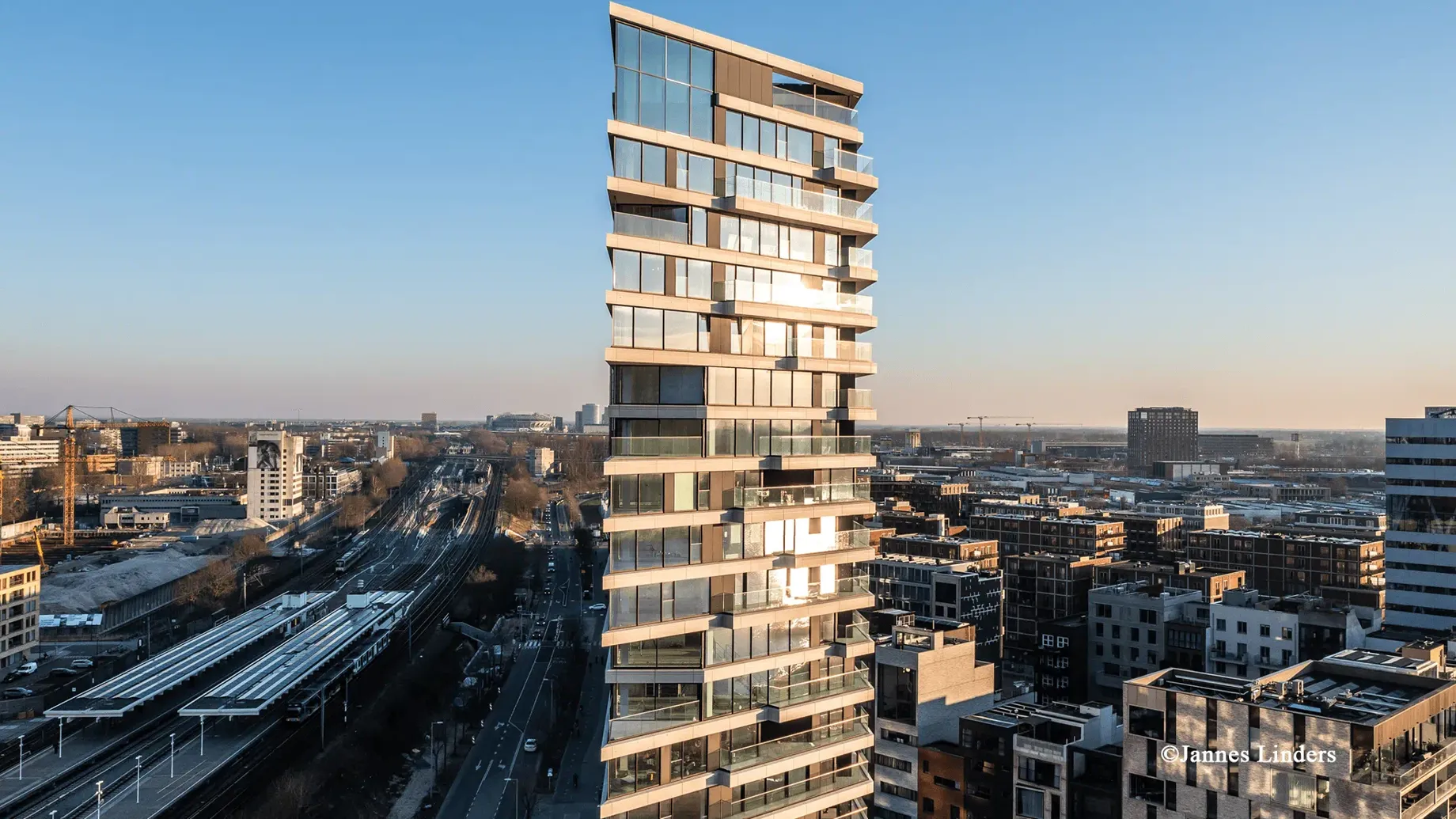
To achieve its climate goals, the Netherlands has committed to becoming climate neutral by 2050. To achieve this, our experience in materials technology and structural engineering is playing a huge part in sustainable construction.
Using timber as a building material is one of the most effective ways of accelerating decarbonisation, as the associated carbon footprint is much lower compared to concrete or steel. In addition, timber acts as a carbon storage for decades to come.
More and more organisations are embracing the climate positive qualities of timber, and in 2021, over 80 Dutch companies signed the Green Deal covenant Houtbouw of the Metropoolregio Amsterdam. With this covenant, Amsterdam is committing to the goal of building at least 1 in 5 residential buildings with timber as the main structural material, from 2025 onwards.
A bio-based project with timber at its heart
In 2016, Amsterdam issued a tender for a building plot near the Amstel river. The municipality emphasised the importance of the designs being both sustainable and of high architectural quality. Together with developer Lingotto and Team V Architectuur, Arup designed a revolutionary timber-hybrid residential tower. Standing an impressive 73 metres tall, the building boasts a transparent and robust appearance along with flexible floor plans to give future residents of the 55 apartments the freedom to personalise their living space.
To engineer this bio-based high rise residential building, our team of specialists delivered the sustainable, structural and technical design as well as focusing on building physics, acoustics and fire engineering. Completed in 2022, HAUT stands 21 floors tall, and is one of the tallest timber-hybrid buildings in the world.

Carbon reduction through materials selection
Bio-based building is gaining global momentum as more and more people embrace the natural qualities of timber. While atmosphere and acoustics are a factor, the most important driver for the increase of timber in residential buildings is the potential to significantly reduce carbon emissions. In HAUT, more than 2000m3 of timber was used, giving a total reduction of 50% of sequestered carbon compared to conventional buildings, storing some 1,800 tonnes of CO₂.
Sustainable, innovative, and clearly modern
To give the tower a transparent appearance and to use sunlight to provide the building with natural heating and optimal lighting conditions, our team designed a façade that consists largely of (triple) glass and integrated PV panels. Combined with the rooftop photovoltaics to create an energy-positive exterior, HAUT generates enough energy to supply the entire building with electricity.
HAUT is a shining example of how innovative sustainability can contribute to the future of buildings, where zero carbon and nature-inclusive design will be the norm. The tower features an ATES system, sensor-controlled installations and low temperature underfloor heating, making it one of the most climate friendly high rise residential buildings in Europe. To add to HAUT’s environmental harmony, a rooftop garden and nest boxes for both birds and bats add to the biodiversity on site.

Hybrid construction following a sustainable mantra
The design principle for HAUT was timber where possible, concrete and steel when necessary. As a result, both the foundation, basement and core were built using concrete. The concrete core provides stability and contributes to the fire safety of the building.
Looking for ways to use as much timber as technically possible, we embarked on a quest for an innovative and affordable technical solution for the mezzanine floors. The result was a custom designed precast timber-concrete composite floor plate developed in close collaboration with Lingotto, Team V Architectuur, contractor J.P. van Eesteren and timber specialist Brüninghoff.
The floor's structure consists of 16cm cross laminated timber with an 8cm concrete top layer. The choice for a hybrid floor plate had big advantages for footfall performance, acoustical performance, construction sequencing and detailing. Due to the low self-weight of the floor plates, trucks could be loaded more efficiently, resulting in fewer deliveries to the building site in the centre of Amsterdam.
Groundbreaking sustainable credentials
HAUT is Arup’s first high rise timber hybrid residential building. With its focus on reducing the building’s carbon footprint from the start of the planning stage, the iconic tower was awarded the International BREEAM Award 2018 even before it was built. HAUT is living proof that the use of bio-based materials can go hand in hand with cutting edge architecture.
In September 2023, HAUT was certified BREEAM-NL Outstanding – an acknowledgement awarded to only a handful of high-rise residential buildings globally, and the first residential project in the Netherlands to achieve this. Thanks to an integrated, multidisciplinary approach and close collaboration with our partners, HAUT has set the standard for high-quality sustainable housing centred around natural building materials.
Team V Architectuur / J.P. van Eesteren
Awards
-
International BREEAM Award 2018
The Arup Journal 2023 Issue 1
Learn more about this project in issue 1 of the Arup Journal for 2023. Explore major transport projects in London and Hong Kong, learn about the Lou Reed listening room in New York and the tallest timber-hybrid residential building in the Netherlands.

Projects
Explore more property projects

Modular sidewalk shed designs will transform New York City’s pedestrian experience
NYC DOB Pedestrian Protection Designs, USA

Creating an all-electric residential complex along Brooklyn’s waterfront
The Riverie, USA

Delivering a seamless user experience for a vibrant mixed-use development in the heart of Detroit
Hudson's Detroit, USA

Serving the greater Houston community with an accessible, cutting-edge facility
Houston Endowment Headquarters, USA
Get in touch with us
If you'd like to speak to one of our property experts about any of the issues raised on this page or a potential collaboration then please get in touch by completing the form.
