
Seattle Convention Center’s Summit building breathes new life into Seattle’s urban core
Seattle Convention Center Summit building
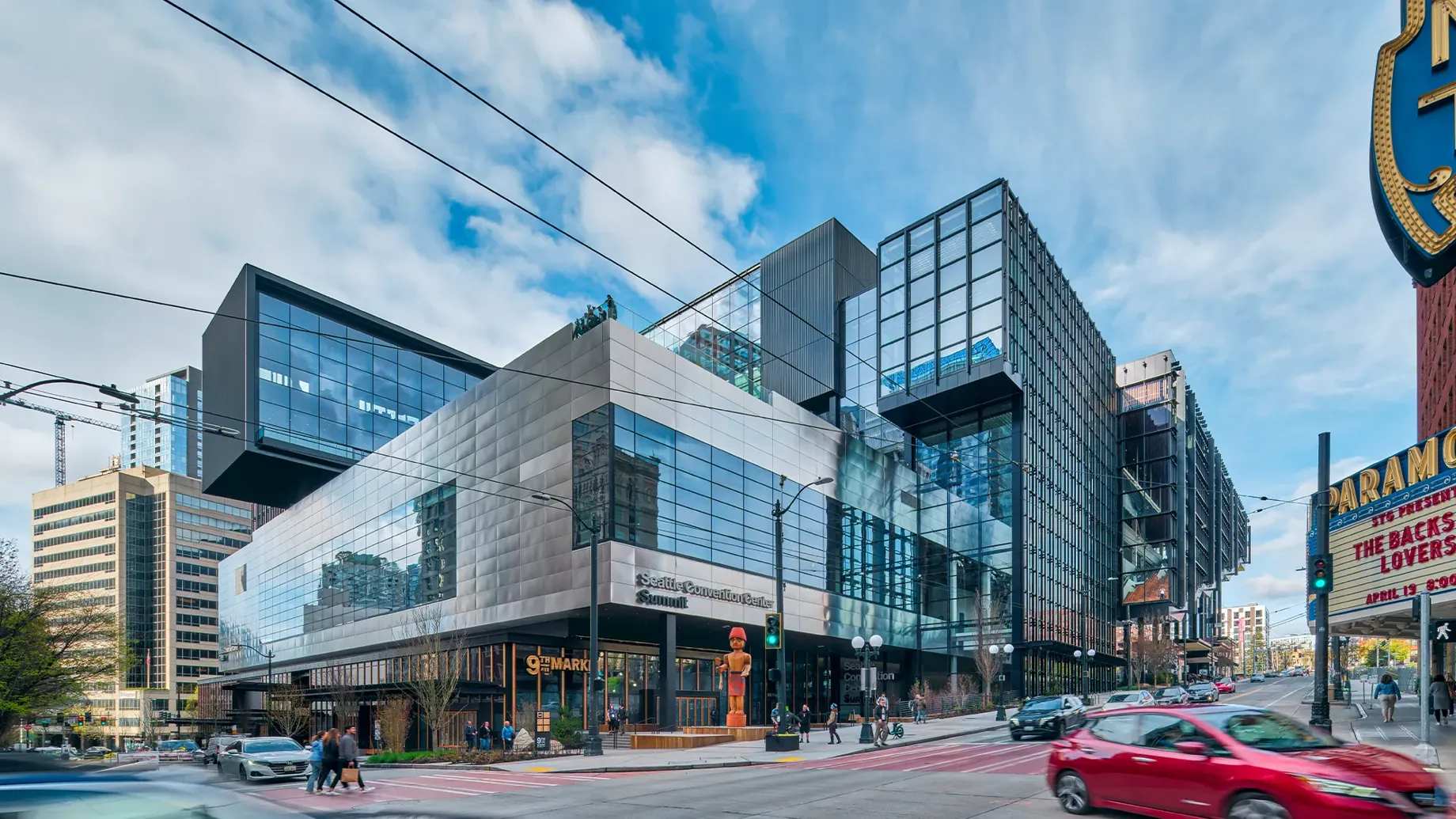
Due to an anticipated increase in usage, the Seattle Convention Center sought to expand its existing footprint with an addition called the Summit. The new building would not only accommodate the higher usage and capacity levels, but also attract more visitors, creating economic opportunities for the city’s diverse businesses, as well as improving the pedestrian experience.
In partnership with LMN Architects, Arup supported the 1.5-million square foot addition, which doubled SCC’s previous capacity. The expansion included a new 30-story residential tower, 16-story office building, and several public gathering spaces. We provided a suite of multidisciplinary services including mechanical, electrical, and plumbing (MEP) engineering, as well as fire safety and code consulting. Arup’s engineering solutions work to minimize energy consumption and maintain optimal air quality, ultimately improving day-to-day operations.
Located in the heart of Seattle’s downtown core, the project has transformed several under-utilized blocks into a thriving mixed-use district and improved connections between Capitol Hill and the waterfront.
Uniting MEP and design to maximize sustainability
The SCC expansion has achieved new national benchmarks in convention center sustainability, including receiving LEED Platinum certification. With these ambitious sustainability goals outlined early in the project, our MEP experts worked closely with the design team to develop integrated MEP systems that redefine performance standards.
The open plan prefuntion areas, connecting to multiple vertical atria and extensive glazed walls, required creative solutions to effectively deliver heating & cooling to the space. We designed a hybrid heating and cooling solution that combines the benefits of variable air volume (VAV) and radiant floor heating and cooling to achieve a high level of comfort while reducing energy use. In addition to being more sustainable than an industry-standard approach, the hybrid approach enabled the design team to maximize ceiling heights and cut floor-to-floor heights, reducing mechanical construction costs by $1m. Together with other energy efficiency measures, including a large solar PV array on SCC’s roof, the project achieves a 38% operational carbon emission reduction compared to baseline performance.
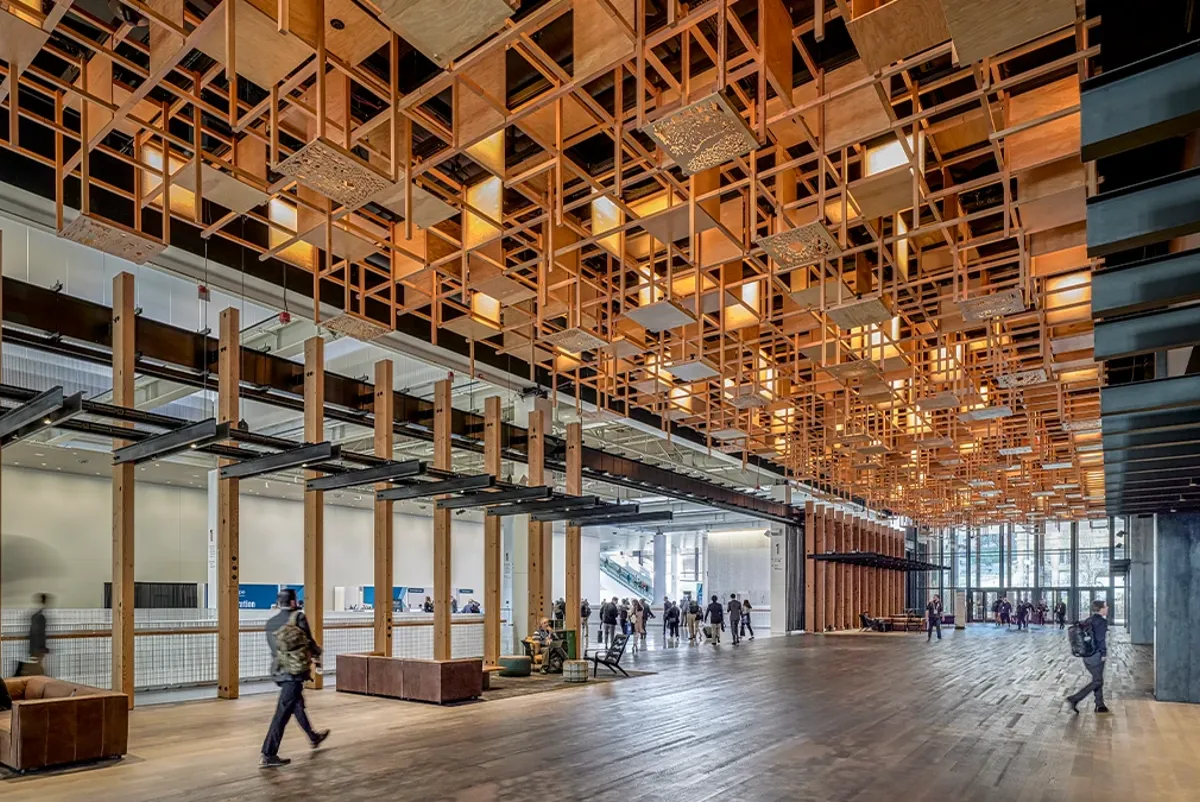
The Summit building’s expansive interior, featuring a timber lattice ceiling, creates a vibrant, welcoming space in Seattle’s reimagined convention center © Tim Griffith
Arup also worked closely with the project team to identify “found” space for a large rainwater harvesting vault, located below the loading dock truck ramp. Arup designed the system to recapture rainwater from the adjacent office tower roof and maximize rainwater reuse, while minimizing cost by connecting the system to SCC’s restrooms with the most expected use throughout the year.
Bringing safety and energy auditing to new heights
Our fire and life safety experts developed a unique performance-based fire engineering strategy that reduced smoke exhaust and makeup air by more than one million cubic feet per minute, enabling the architect to achieve the desired space usage and interconnectivity goals. The performance-based design allowed for reduced exit widths using modeled egress timing and computational fluid dynamics fire simulations. The team worked closely with the Seattle Fire Department and Seattle Department of Construction and Inspection to ensure all life safety and fire-fighting needs were met, while allowing over 200ft of vertical connectivity from the below-grade exhibit hall to the ballroom level at the top of the Summit building.
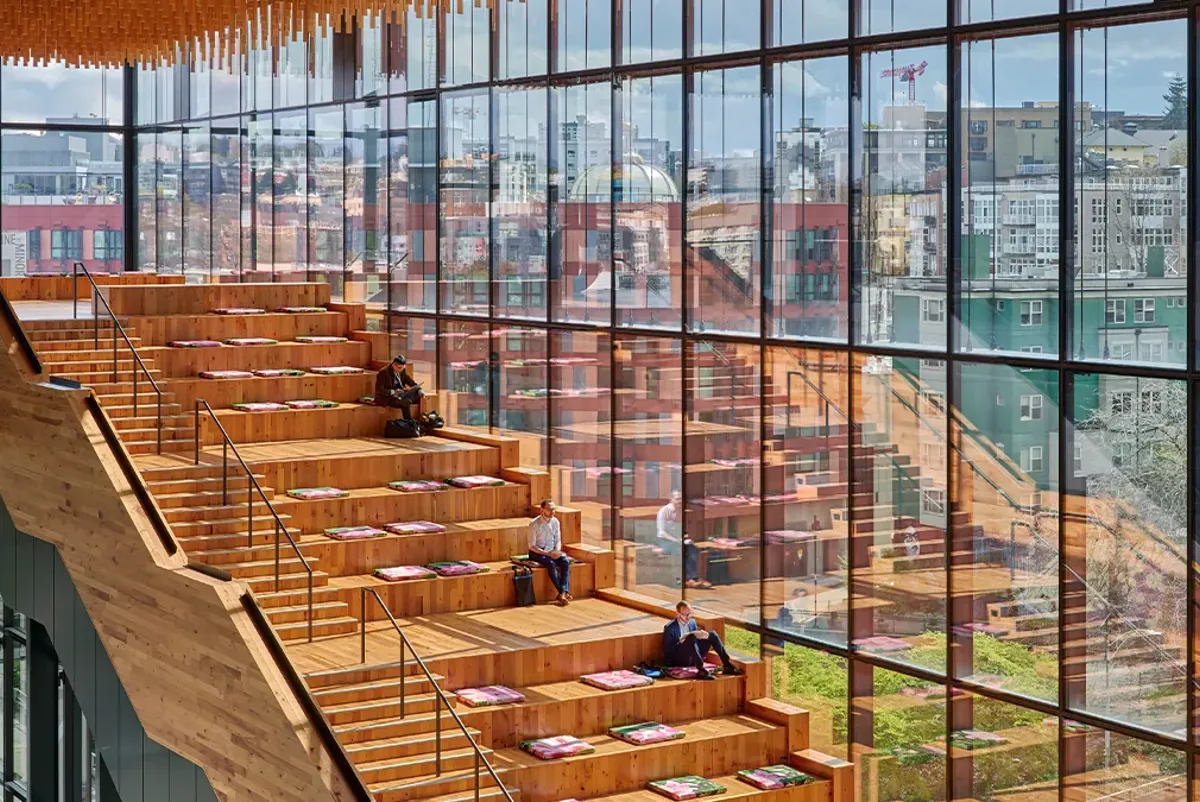
Summit's tiered seating with floor-to-ceiling windows provides an open space for work and informal gatherings © Tim Griffith
Driving efficient building practices with digital tools
Arup used Building Information Modelling (BIM) to increase workflow efficiency by providing models that enable rapid design iteration and automatically generate solutions. To accelerate coordination and enhance constructability early in the design process, the contractor’s BIM detailers worked alongside our team to co-create a detailed BIM model for the Summit building. This digital-forward approach allowed the construction team to provide critical constructability input, which was of particular importance as single duct fittings can weigh as much as 20,000lbs.
In addition, recent changes in Seattle’s envelope requirements meant that early studies were crucial to achieving compliance along with the architectural vision for the new addition. Arup evaluated multiple approaches in the early phases of design using Rhino and Grasshopper. We also created custom tools with Rhino and EnergyPlus to generate building performance models. This approach aided the client with vetting various mechanical and architectural design options, which helped identify a design approach with the lowest cost and least risk.
LMN Architects / Pine Street Group / Clark Construction-Lease Crutcher Lewis JV / FSi Consulting / Magnusson Klemencic Associates / Pielow Consulting / SM&W
Awards
-
2022 Seattle 2030 District Vision Awards
Vision Award for Potable Water Use Reduction
-
2023 AIA Seattle Honor Awards
Honorable Mention
-
Urban Land Institute
2024 Americas Awards for Excellence
Projects
Explore more property projects

Modular sidewalk shed designs will transform New York City’s pedestrian experience
NYC DOB Pedestrian Protection Designs, USA

Creating an all-electric residential complex along Brooklyn’s waterfront
The Riverie, USA

Delivering a seamless user experience for a vibrant mixed-use development in the heart of Detroit
Hudson's Detroit, USA

Serving the greater Houston community with an accessible, cutting-edge facility
Houston Endowment Headquarters, USA
Get in touch with us
If you'd like to speak to one of our property experts about any of the issues raised on this page or a potential collaboration then please get in touch by completing the form.
