
Engineering one of the longest cable-stayed bridges in the United States
US 181 New Harbor Bridge
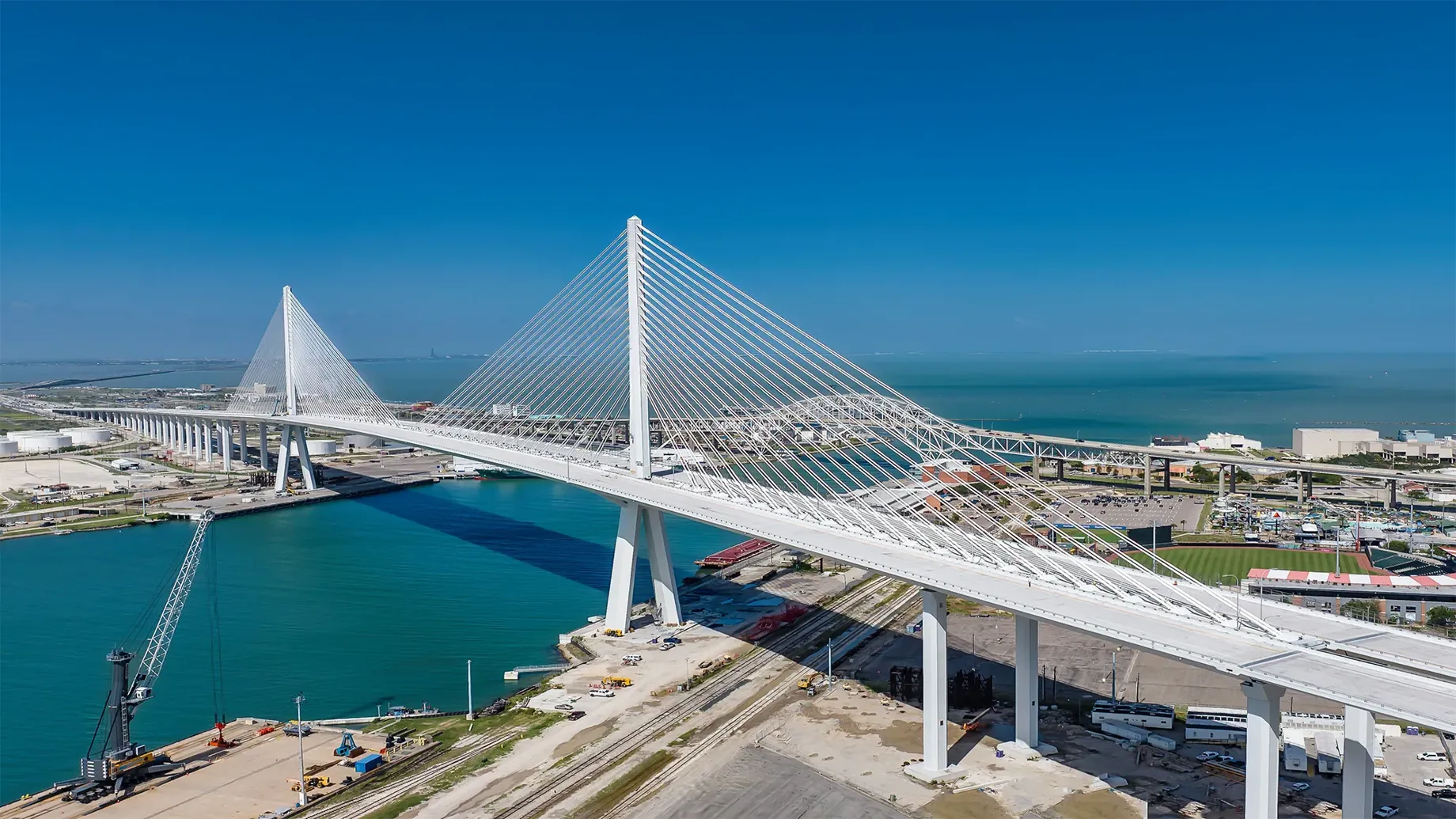
A critical transportation corridor, the Harbor Bridge carries commuters along U.S. Route 181 in the coastal city of Corpus Christi, Texas. The Texas Department of Transportation (TxDOT) required a replacement bridge that would enhance safety, mobility, and regional connectivity for all users, including pedestrians and cyclists. The structure needed to reduce long‑term maintenance demands in a harsh coastal environment while supporting future traffic growth and fostering regional economic development through increased capacity and improved safety performance.
Arup served as the Engineer of Record for the cable-stayed bridge, working closely with TxDOT’s chosen developer, Flatiron/Dragados, LLC (FDLLC), and joint venture design partner, Carlos Fernandez Casado, S. L., Arup contributed to an essential upgrade to this major Texas throughfare by providing engineering and construction support accompanied by full-time, on-site presence.
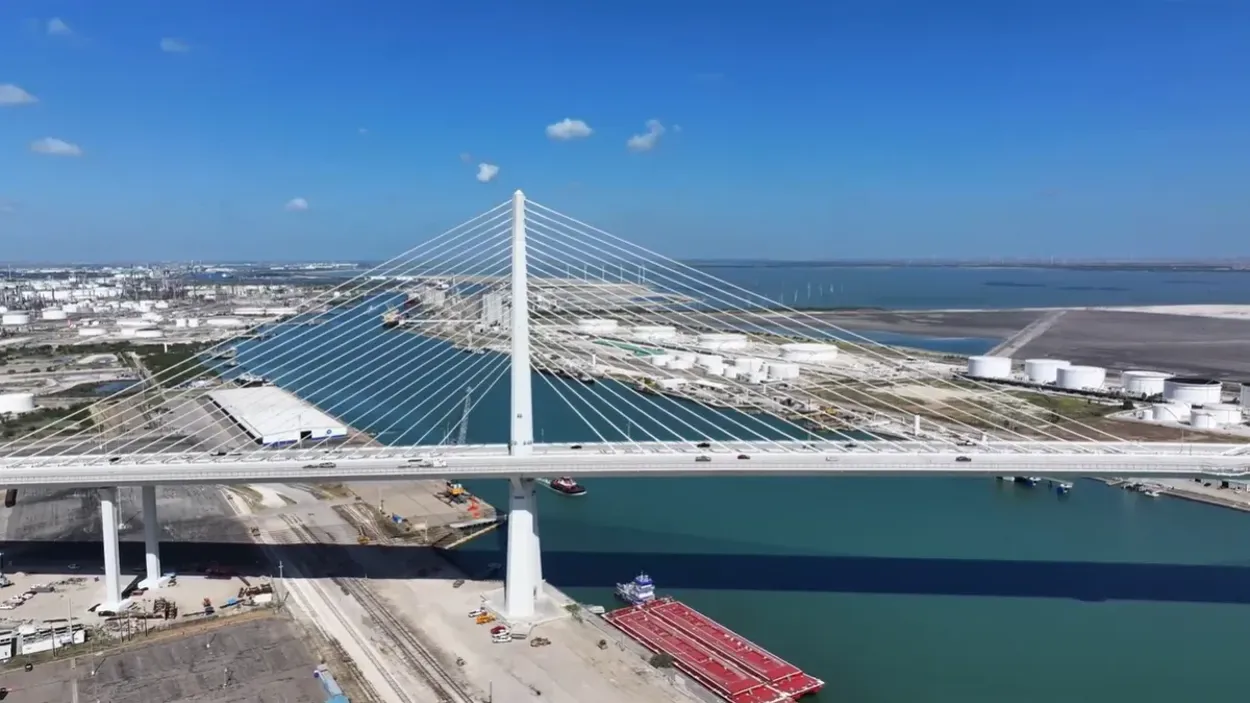
Opened in 2025, the New Harbor Bridge dramatically improves the safety challenges faced by the former bridge with the inclusion of six traffic lanes, full-width shoulders, and a dedicated shared-use path for pedestrians and cyclists. The new bridge is designed to withstand the next 170 years, far exceeding typical bridge service life, thus providing an inherently sustainable structure. Situated along the Texas coast with the threat of hurricanes, resiliency was a key design requirement performed by Arup's wind engineering team.
Operationally, the new bridge provides 205ft of vertical clearance and 514ft of horizontal clearance to support improved marine navigation and accommodate larger ships. Both support tower substructures are built on land and protected from potential collisions within the waterway.
Advanced engineering to deliver a record-setting span
The new Harbor Bridge challenged the limits of precast concrete segmental design and construction. The design team achieved the longest precast concrete segmental main span ever constructed (1,661ft), as well as the widest delta-frame connected cross section (nearly 150ft).
Innovative materials were essential to protecting the major structural components from the corrosive marine environment while meeting TxDOT’s sustainability goals. Arup used high-performance concrete designs to achieve both the demanding 10-ksi compressive strength requirement and the project’s 170-year extended service life requirement. The corrosion protection for the stay cable’s high-strength steel strands utilized epoxy coated and filled (ECF) strands, an innovation for long-term corrosion protection which is gaining popularity in the United States for its use in stay cables and unducted-ungrouted external tendon applications.
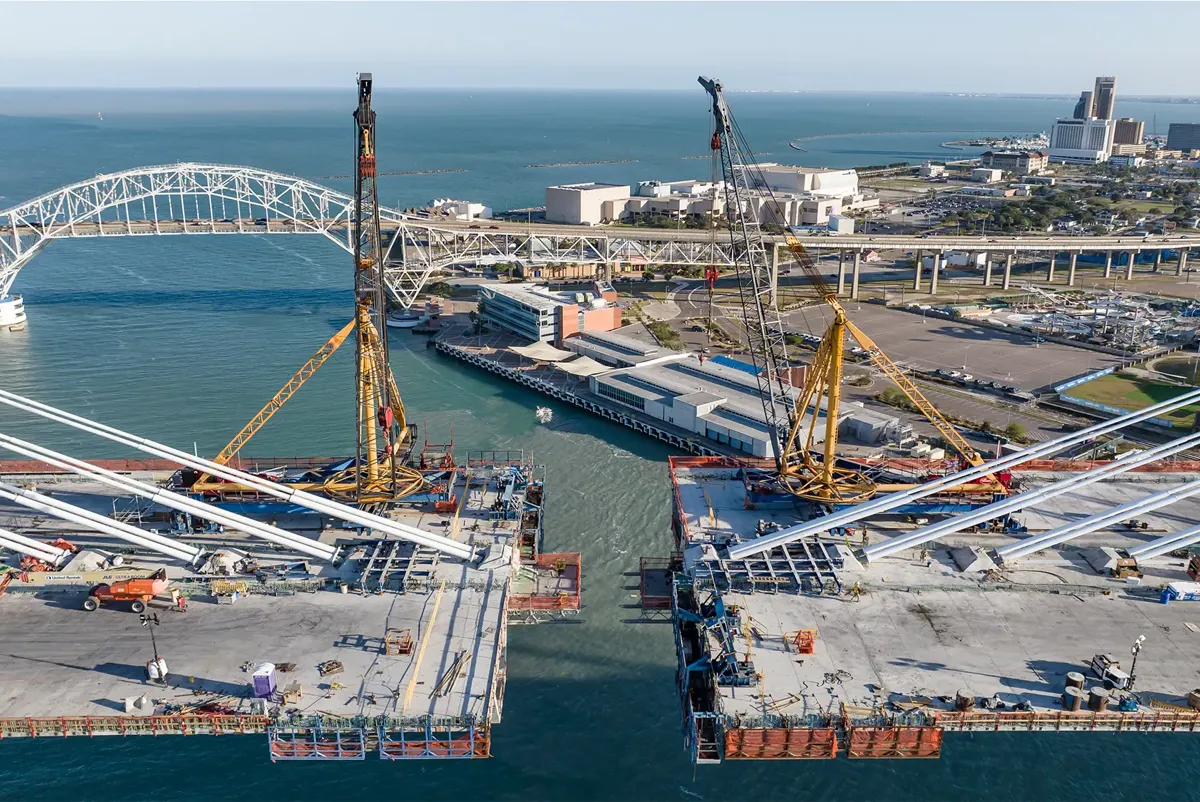
The effective geometry control allowed each side of the main span to meet in the middle within a fraction of an inch. © Harbor Bridge Project
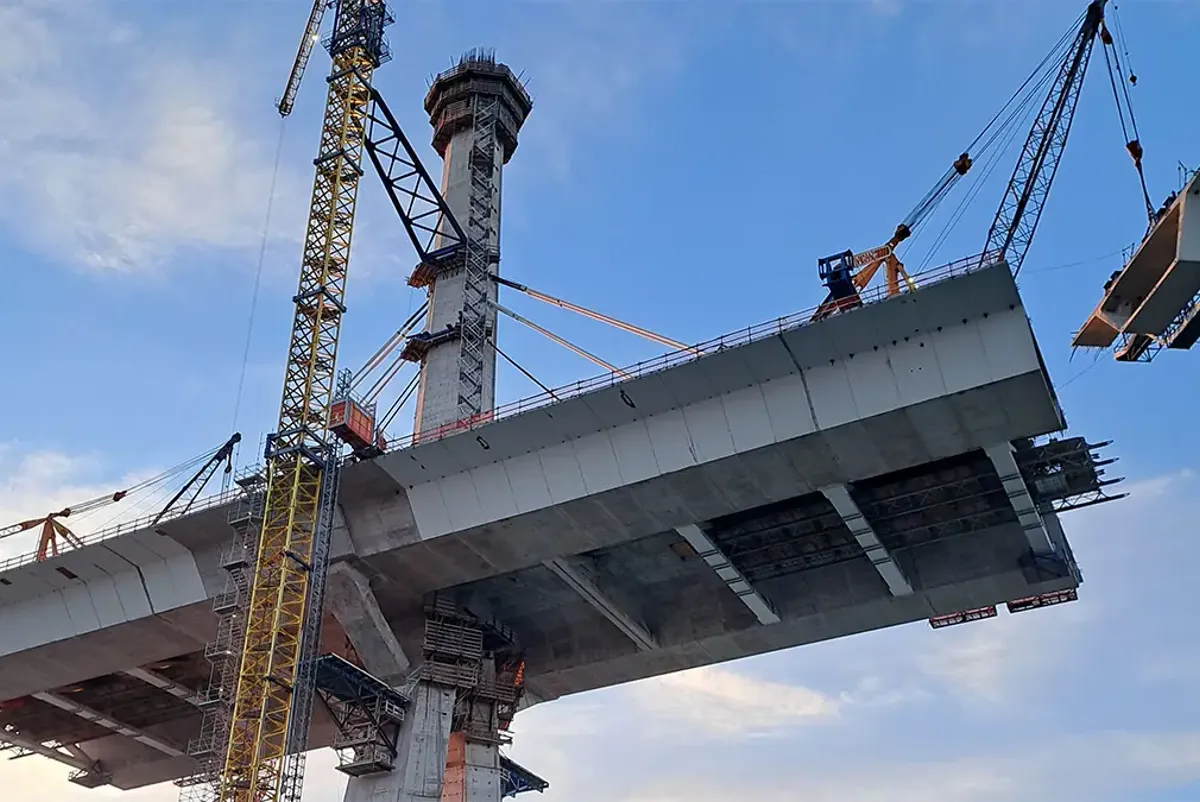
Arup used high-performance concrete designs to achieve both the demanding 10-ksi compressive strength requirement and the project’s 170-year extended service life requirement. © Harbor Bridge Project
Leveraging detailed analysis and geometry control
Geometry control was a critical part of the New Harbor Bridge. The bridge’s size and complexity required highly precise and accurate surveying of the pylons and box girders to ensure proper structural performance and geometric profile was achieved.
In collaboration with the builder’s means and methods, Arup developed a comprehensive geometry control plan, defining target geometry based on the specific phase of construction, storage of equipment, and material atop the deck, as well as the effects of temperature induced deformations. The pylons were designed to accommodate the predicted long-term settlement, with the lower legs designed for stability and the upper towers built with a slight vertical precamber to keep the deck and stay cable anchors properly aligned. The box girders also included vertical and twist precambers to counteract the unique cable arrangement and expected deformations. To ensure the bridge maintains its intended shape and clearances throughout its life, the target geometry was calculated for a reference condition of 70°F and projected 30,000 days after construction, accounting for long-term effects.
Early in the project, the team conducted local surveys to ensure that the as-erected geometry matched the as-cast geometry established in the precast yard, while global surveys provided a snapshot of the bridge’s behavior for comparison with the construction stage. Stay-cable forces were also measured, using liftoff procedures and instrumentation readouts.
The effectiveness of the geometry control plan was ultimately realized during the closure of the main span. The cantilevers from each side met within a fraction of an inch compared to the predicted difference, a testament to the dedication and skill provided by Arup, CFC, and FDLLC.
Prioritizing durability and resilience for a critical crossing
With its location in a region potentially susceptible to hurricanes, the New Harbor Bridge needed to not only meet current transportation needs but also withstand the harsh coastal environment for generations. To optimize both strength and durability, high-performance concrete was utilized with compressive strengths exceeding 10-ksi while also achieving the 170-year extended service life requirement, creating a new benchmark for sustainability in bridge construction.
Corrosion protection was another key aspect of the design, including the use of epoxy-coated and filled strand for the stay cables, a relatively new technology in the United States. This approach provided enhanced protection for the high-strength steel strands, which are especially vulnerable in coastal conditions.
The bridge’s design also centered on efficient and streamlined construction methods. Precasting of concrete segments off-site allowed for better quality control, reduced waste, and minimized disruption to the local environment. These choices reflect the project team’s commitment to integrating efficiency into both the design and delivery of major infrastructure projects.
The connection and meeting of the two spans within a fraction of an inch shows the amount of precision, care and expertise taken with the design and construction of the bridge.
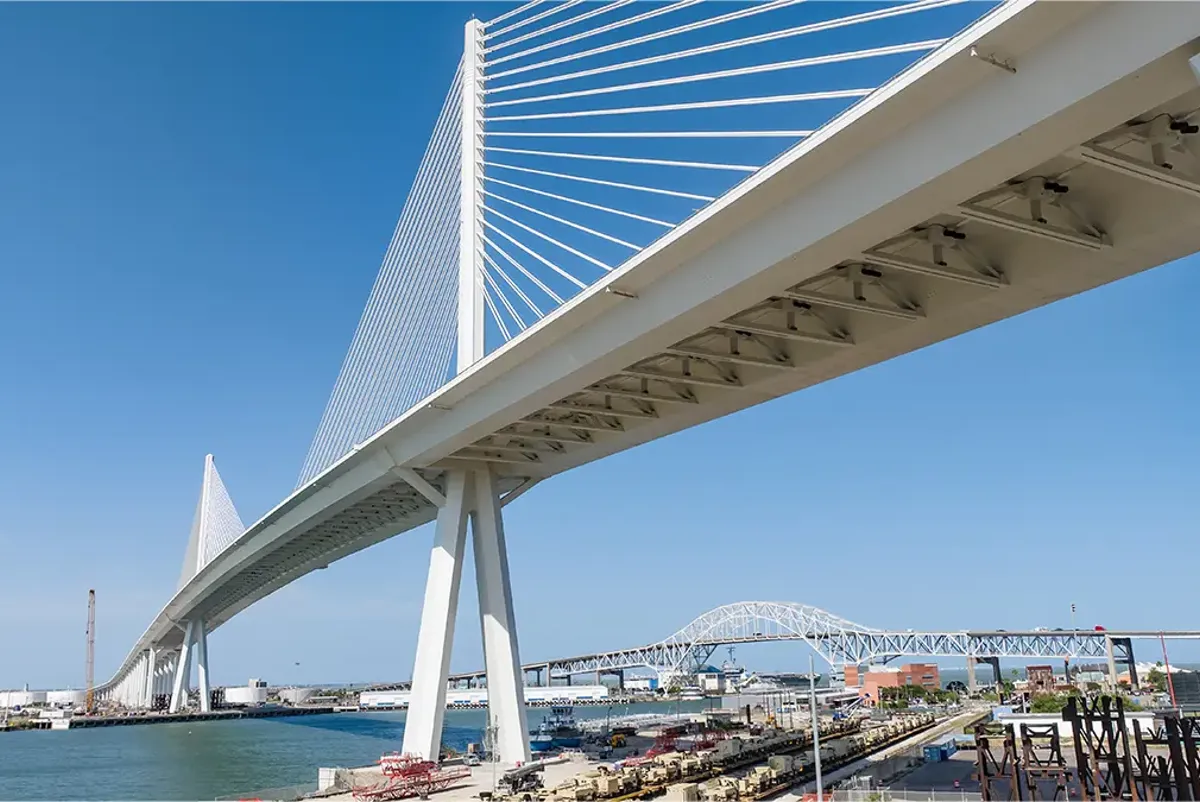
Arup contributed to an essential upgrade to this major Texas throughfare by providing engineering and construction support accompanied by full-time, on-site presence. © Harbor Bridge Project
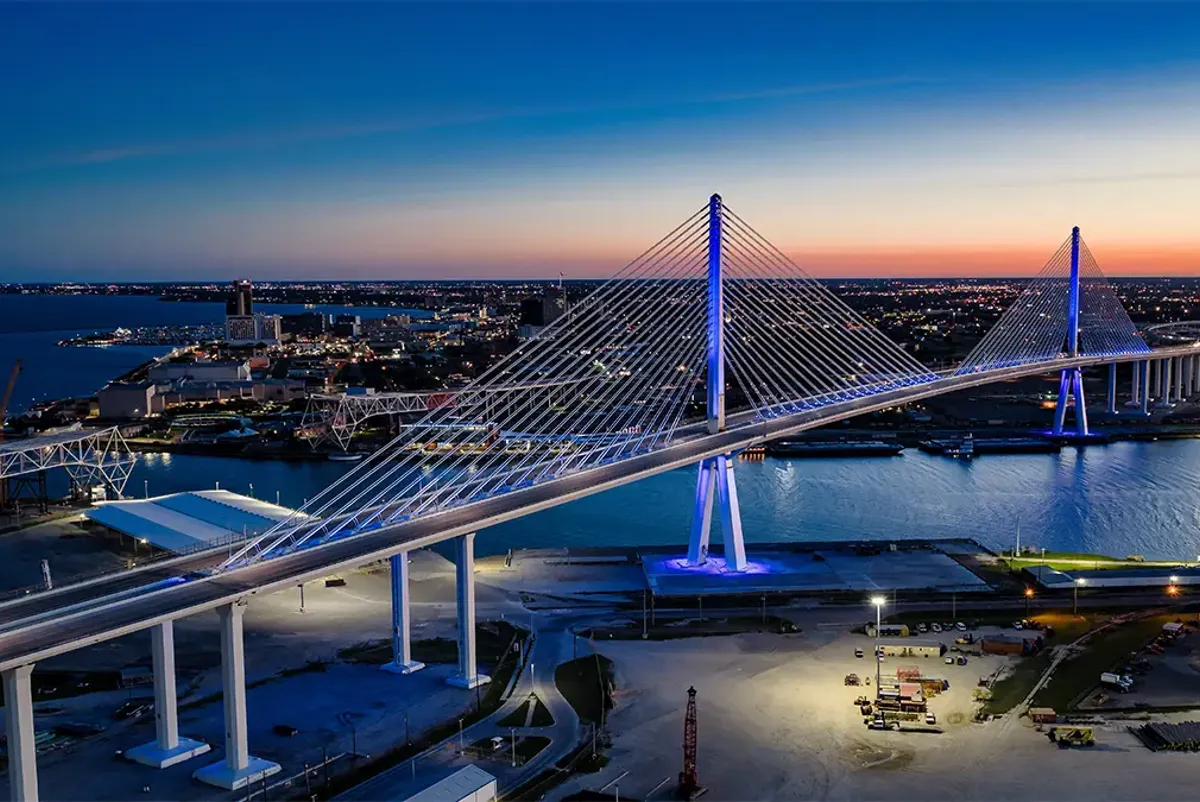
Opened in 2025, the New Harbor Bridge dramatically improves the safety challenges faced by the former bridge with the inclusion of six traffic lanes, full-width shoulders, and a dedicated shared-use path for pedestrians and cyclists.© Harbor Bridge Project
Texas Department of Transportation (Owner)
Carlos Fernández Casado S.L.
Awards
-
American Segmental Bridge Institute (ASBI) 2025
Bridge Award of Excellence
-
American Infrastructure Magazine 2025
Bridge of the Year
-
American Council of Engineering Companies of New York (ACEC-NY) 2026
Engineering Excellence Award, Platinum Level
-
Fédération internationale du béton – International Federation for Structural Concrete (fib)e 2026
Outstanding Concrete Structures
-
Roads and Bridges Magazine, 2025
#1 Bridge, Top 10 Bridges
Projects
Explore more bridge engineering projects

California’s first long-span cable-stayed bridge
Long Beach International Gateway Bridge, USA

Designing Australia’s first extradosed bridge
Swan River Crossings Fremantle Traffic Bridge, Australia

Strengthening Suurhoff bridge with innovations in bridge renovation
Suurhoff bridge, Netherlands

A bridge to grow Brisbane’s active transport network
Kangaroo Point Bridge, Australia
Get in touch with us
If you'd like to speak to one of our roads and streets experts about any of the issues raised on this page or a potential collaboration then please get in touch by completing the form.
