
Improving a major bridge and highway connection in Montreal
Samuel De Champlain Bridge Corridor

The Samuel De Champlain Bridge Corridor is an outstanding example of Arup's global expertise, bringing an innovative and collaborative approach to the procurement of a multi-billion-dollar infrastructure project in Canada.
A landmark gateway to Montreal
In June 2019, Montreal celebrated the opening of the 3.4km Samuel De Champlain Bridge, one of the largest and busiest bridges in North America. Crossing the Saint Lawrence River and its international shipping channel, it is a vital thoroughfare for both goods and people, accommodating more than 50 million crossings and facilitating CAD$20 billion of trade every year. Built through a public private partnership (PPP) between the Government of Canada (via Infrastructure Canada) and the Signature on the Saint Lawrence Group, it is a landmark structure that creates a gateway to the city of Montreal.
By providing timely, comprehensive technical and procurement advice, we helped the Government of Canada meet every project deadline to achieve an incredibly aggressive procurement schedule two and a half years ahead of time. Our expertise and experience meant that an essential piece of infrastructure was delivered earlier than planned and well within budget.
Designing a dedicated transit network
The construction of the bridge was part of the CAD$4.24 billion Samuel De Champlain Bridge Corridor Project, a major urban highway improvement project in the Montreal metropolitan area and one of the largest infrastructure schemes in North America. The project encompassed the construction of the 500m Île des Sœurs Bridge and the renewal of 8.5km of highway. Including a dedicated public transport scheme and an enhanced network of pedestrian and cycling paths throughout the corridor, Arup also provided futureproof planning for a light rail transit system in our plan.

Building the business case first
Since 2012 Arup has provided expert technical advice to the Government of Canada to facilitate the replacement of the 3.4km-long Champlain Bridge over the St Lawrence River and Seaway and 4km of congested urban highway. It is one of the busiest corridors in Canada, vital to both the local and national economy.
Our global team delivered a technically viable, affordable solution for inclusion in the 2013 business case. This established project costs and the best means of procurement. When the condition of the existing bridge deteriorated in the Fall of 2013, the demand accelerated. We accepted the challenge of developing the design and technical requirements for such a complex PPP project, completing and releasing the RFQ and RFP in nine months.
A bridge for the ages
Our challenge was compounded by the objective to deliver a high quality architectural solution and achieve a bridge with a 125-year design life. Leading an integrated team of engineers and architects including Danish architects Dissing+Weitling and local architects Provencher_Roy, our remit was to create a unique, signature bridge design sensitive to the needs of Montreal and with the architectural vision to become an icon on the St. Lawrence River for the city of Montreal, the country of Canada, and the world itself.
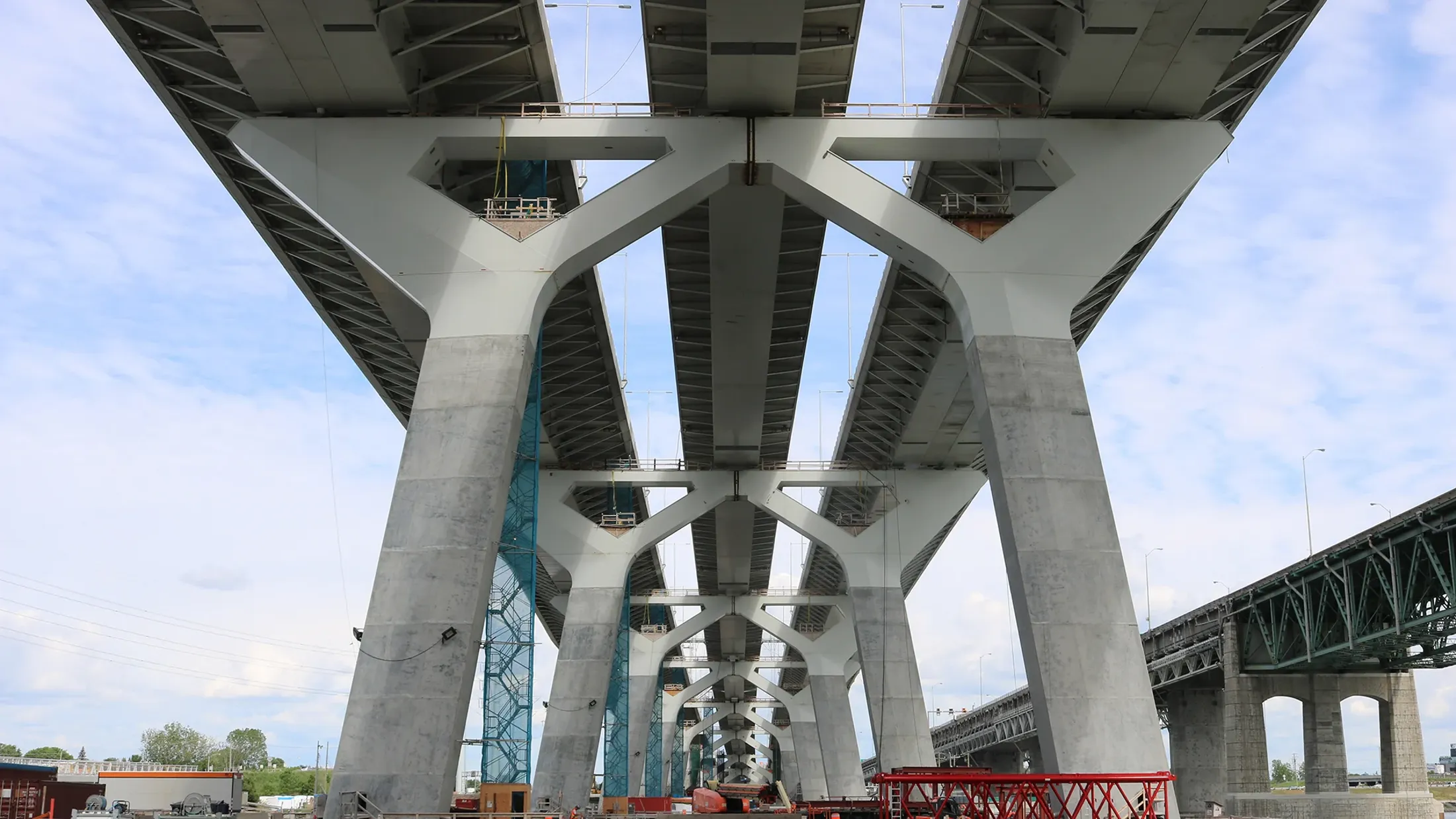
Our solution of a curved alignment with sculptural piers created an instantly recognisable shore-to-shore design. An elegant 160m main tower supports the wide asymmetric cable-stayed bridge, and a ‘harp’ of cables adds a unique accent to the bridge.

Delivering an iconic solution for Montreal
Arup developed preliminary designs and contractual documentation to meet the client and external stakeholder’s requirements for a durable, high quality and architecturally pleasing bridge.
By drawing on our experience from the Queensferry Crossing and Oresund bridge, we knew that the most effective means of ensuring high-quality design was to develop both reference and definition designs in parallel with the development of the technical requirements and tender documents. These designs served two distinct and complementary functions:
- Helping to define the project’s technical requirements to inform cost and schedule estimates (through the reference design)
- Clarifying the owner’s aesthetic intentions to the bidders, ensuring that technical and visual dimensions of the design are considered simultaneously, and providing a plan for safeguarding architectural integrity through the final stages of the project (through the definition design)
While it is common to prepare a reference design, clients do not typically focus their attention on it as they know that the final design will almost certainly be different. In this case, we developed a reference design that included several key points. We wanted to demonstrate a technically viable design which respected the project schedule, and that was architecturally pleasing and cost effective. We then used this reference design to prepare the definition design, a set of drawings showing the requirements for configuration, geometry, and form for the final bridge.
A tangible benefit of this approach was that it allowed the Government of Canada to confidently release images of the new bridge in summer 2014, even before the selection of a PPP partner. This served to confirm to the public and stakeholders that, on the selection of a consortium to complete the design and construction, the bridge would respect the design intent proposed by Arup.
Dissing+Weitling architecture / Groupe S.M. International Inc. / Loctrans / Provencher Roy Associés Architectes
Projects
Explore more roads and streets projects

An actionable framework for safer public roadways providing access to BART stations
Safe Trips to BART, USA

Connecting Los Angeles communities in a sustainable way
Taylor Yard Bikeway and Pedestrian Bridge, USA

Engineering one of the longest cable-stayed bridges in the United States
US 181 New Harbor Bridge, USA

Renewable energy microgrid pioneers decarbonizing model for an EV bus transit system
Martha's Vineyard Transit Authority microgrid, USA
Get in touch with us
If you'd like to speak to one of our roads and streets experts about any of the issues raised on this page or a potential collaboration then please get in touch by completing the form.
