
A net-positive botanical garden built for research and resilience
Marie Selby Botanical Gardens
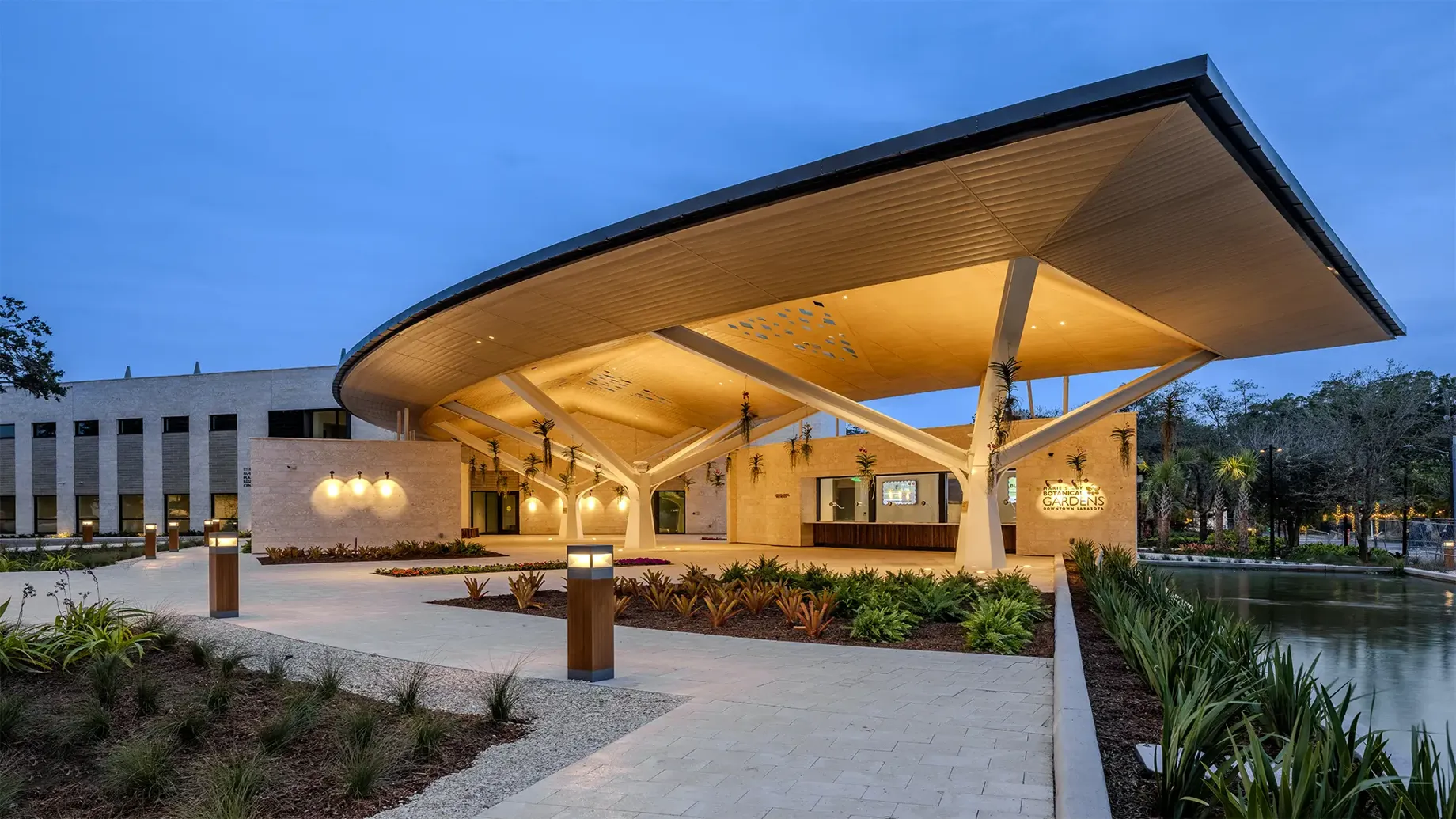
Located on Sarasota Bay in Florida, Marie Selby Botanical Gardens has transformed facilities on its campus to become one of the world’s first botanical garden complexes to be energy net positive. Delivered as phase one of a long-term masterplan, the new facilities expand research, education and visitor experience while producing more energy annually than the campus is projected to consume. At the same time, the project needed to protect globally significant orchid and epiphyte collections on a site exposed to flooding, hurricanes and other climate risks.
Working with Overland Partners, Olin Studio and Kimley-Horn, Arup delivered structural, mechanical, electrical and public health engineering, alongside energy, sustainability, acoustics, lighting, and technology consultancy. We helped translate an ambitious sustainability vision into buildable outcomes across the Morganroth Family Living Energy Access Facility (LEAF), the Jean Goldstein Welcome Center, and the Steinwachs Family Plant Research Center, combining technical performance with regenerative design.
Designed to align with the International Living Future Institute (ILFI) Living Community Challenge framework, the campus demonstrates how infrastructure can support both ecological systems and the community. Its 877 kW DC rooftop solar photovoltaic (PV) array, made up of 2,158 panels, is projected to generate around 5% more energy annually than the campus consumes, while flood-resilient design protects sensitive collections and key systems in one of the country’s most climate-exposed coastal environments.
Engineering net-positive performance
Arup’s structural, mechanical, electrical, and public health engineering delivered ambitious sustainability goals into reality. Across the new campus, the project team designed building systems to reduce energy demand while supporting the distinct needs of research, hospitality and visitor spaces. This work was central to the project’s net-positive energy target, with every major load, from laboratory equipment to kitchen appliances, evaluated to understand its impact on annual performance.
In the LEAF, the project team helped shape the restaurant, retail and parking facility beneath a large rooftop solar PV array designed to produce more energy than the campus consumes annually and provide backup power for storm outage. Meeting the goal of an all-electric kitchen required close coordination with the restaurant operator and wider design team to reduce demand without compromising the functionality of a full-service restaurant. The resulting design balanced operational requirements with rigorous performance targets, demonstrating how building services engineering can support both everyday use and regenerative outcomes.
In the Steinwachs Family Plant Research Center, that houses a collection of more than 20,000 living plants, Arup designed mechanical, electrical, and public health systems to protect irreplaceable scientific collections in a high-risk coastal setting. The building’s services were engineered to maintain stable temperature and humidity conditions for seed repositories, preserved specimens, and research spaces, while resilience measures included elevating critical systems above flood levels and providing backup power aligned with project requirements.
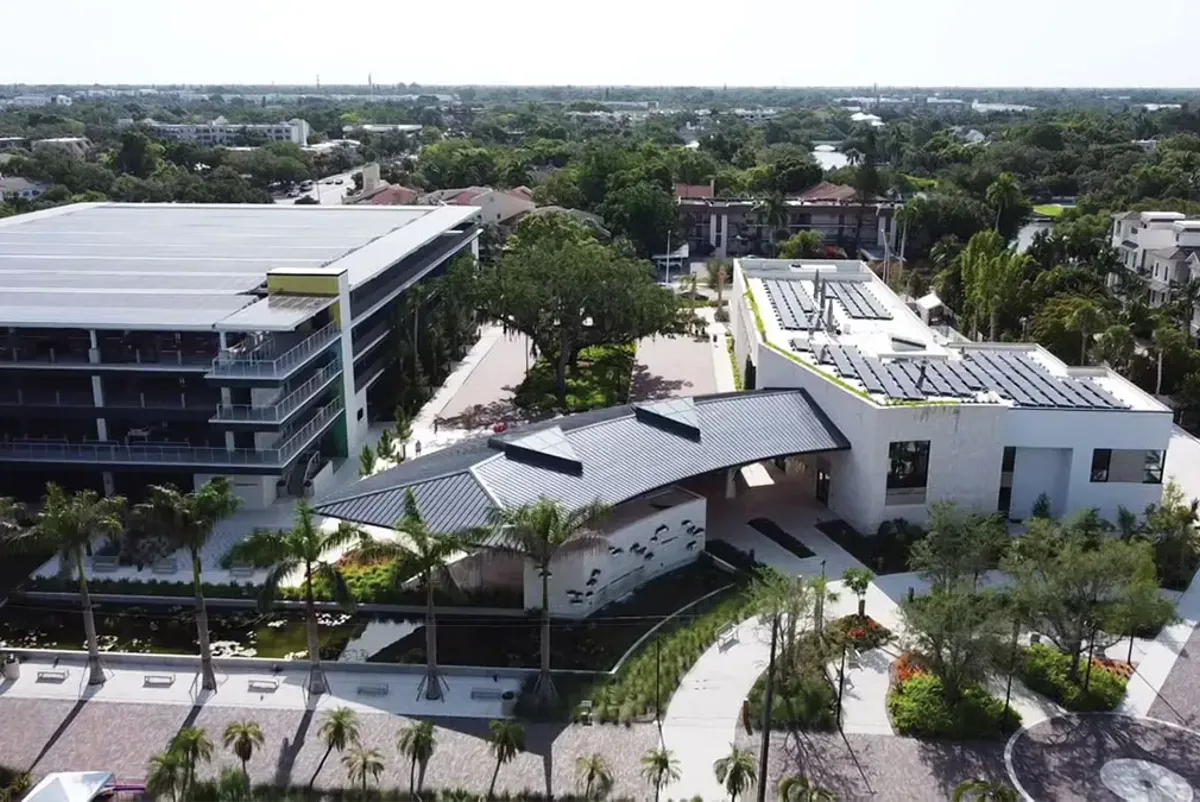
Arup’s structural, mechanical, electrical, and public health engineering delivered ambitious sustainability goals into reality. © Overland Partners
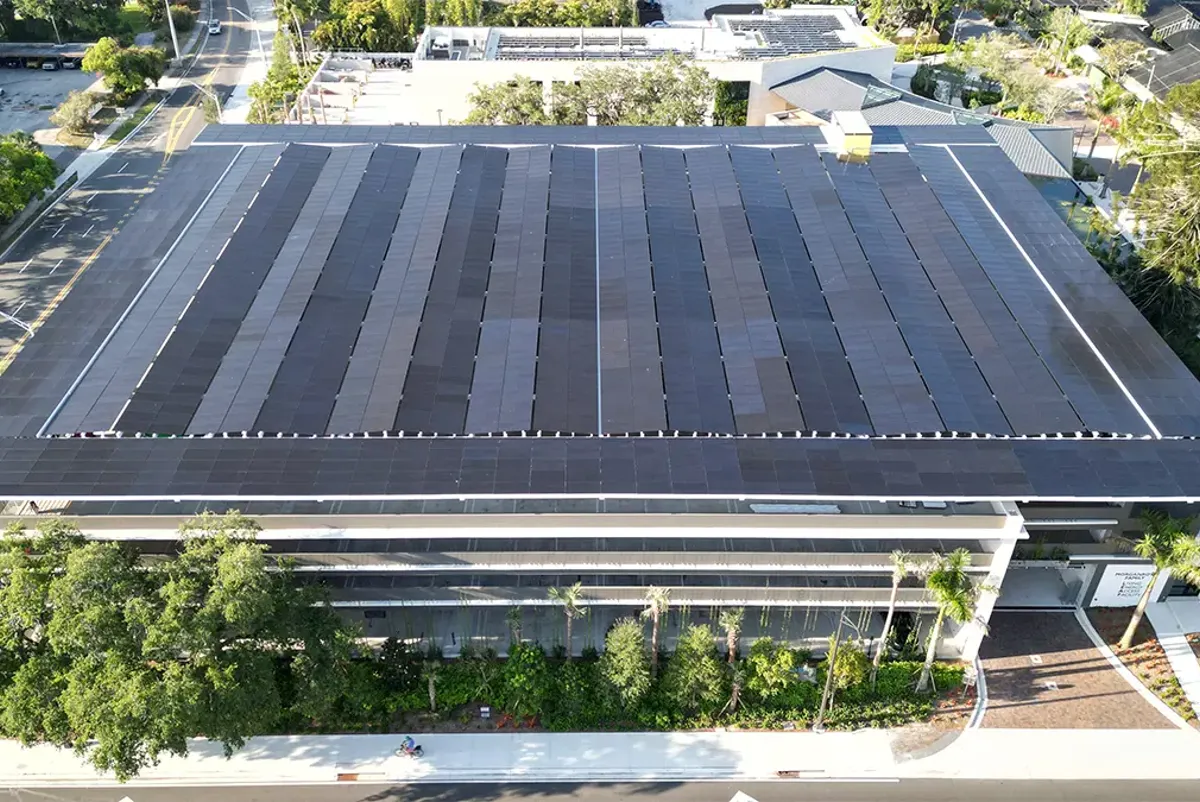
Arup helped align sustainability goals, client operations and technical delivery to support a regenerative vision for the gardens with the wider project team. © Overland Partners
Shaping resilient structures inspired by coastal Florida nature
Arup’s structural engineering helped shape a campus that is both expressive and resilient, drawing directly from the natural systems Marie Selby Botanical Gardens aims to protect. At the Jean Goldstein Welcome Center, our team worked with the architect, Overland Partners, to develop an open-air structure inspired by the trees of coastal Florida and the way they withstand hurricane forces. Three steel ‘quadripods’ form the building’s root, trunk, branch, and canopy, creating a lightweight structural language that reduces enclosed space while strengthening the visual connection between the architecture and the surrounding gardens. Using 3D Rhino modelling to define the roof geometry, Arup helped realise a form that is both technically robust while meeting the project’s biophilic design ambitions.
Across the wider campus, the structural design balanced performance, constructability and resilience in a demanding coastal environment. For the LEAF, the structure was reworked reducing the building in height from five to three storeys, with a post-tensioned concrete solution used in place of a conventional precast scheme and the exterior columns repositioned away from the perimeter with balanced cantilever spans enabling a thinner floor plate profile. This reduced material use and created a lighter profile that better fits the surrounding community. In the Steinwachs Family Plant Research Center, structural strategies supported long-term protection of critical collections by elevating the most sensitive spaces and systems above flood risk.
Arup was a thoughtful, design partner in our shared work at Marie Selby Botanical Gardens. Their strong technical rigor and clear understanding of our shared design intent helped shape a complex ambition into a built reality. We know the project will have lasting positive impact over time thanks to this deeply integrated collaboration.
Embedding regenerative performance across design and operations
Working alongside the wider project team from the outset, Arup helped align sustainability goals, client operations and technical delivery to support a regenerative vision for the gardens. That approach informed strategies ranging from on-site renewable energy generation and rain gardens to rooftop food production and stormwater reuse, helping turn an ambitious masterplan into one of the world’s first botanical garden complexes designed to be energy net positive.
Arup supported the project’s pursuit of Energy, Place, and Beauty Petal certification through the Living Building Challenge framework, while also helping evaluate the energy implications of systems across the campus, from restaurant operations to scientific equipment. This level of coordination was critical to delivering a campus projected to generate 5% more energy annually than it consumes, while also strengthening climate resilience through measures such as elevated critical infrastructure, flood-resistant lower levels, and battery-backed power support.
Arup assessed the energy demands across diverse campus functions, from restaurant operations and visitor facilities to research laboratories and scientific equipment, to right-size and strategically deploy on-site renewable generation and energy storage, reducing reliance on the grid. Together with flood-resilient planning (including elevated critical infrastructure and recoverable lower levels), this approach strengthened the campus’s ability to withstand grid disruption and adapt to future changes in use, technology and climate conditions.
Header image © Marie Selby Botanical Gardens / Ryan Gamma Photography
Kimley Horn / Olin Studio / One80 Solar
Projects
Explore more arts and culture projects

Renewing Sydney Opera House’s Concert Hall, a world-leading contemporary art venue
Sydney Opera House Concert Hall Renewal, Australia

Delivering lighting, acoustics, AV, and theater design for the Theodore Roosevelt Presidential Library
Theodore Roosevelt Presidential Library, USA

La Sagrada Família: a collaboration in digital and stone
Sagrada Família, Spain

Revitalizing the National Geographic Society’s headquarters with a new Museum of Exploration to showcase storytelling for explorers of the future
National Geographic Museum of Exploration, USA
Get in touch with us
If you'd like to speak to one of our arts and culture experts then please get in touch by completing the form.
