
Designing a transformative multi-modal gateway to Los Angeles
LAX/Metro Transit Center
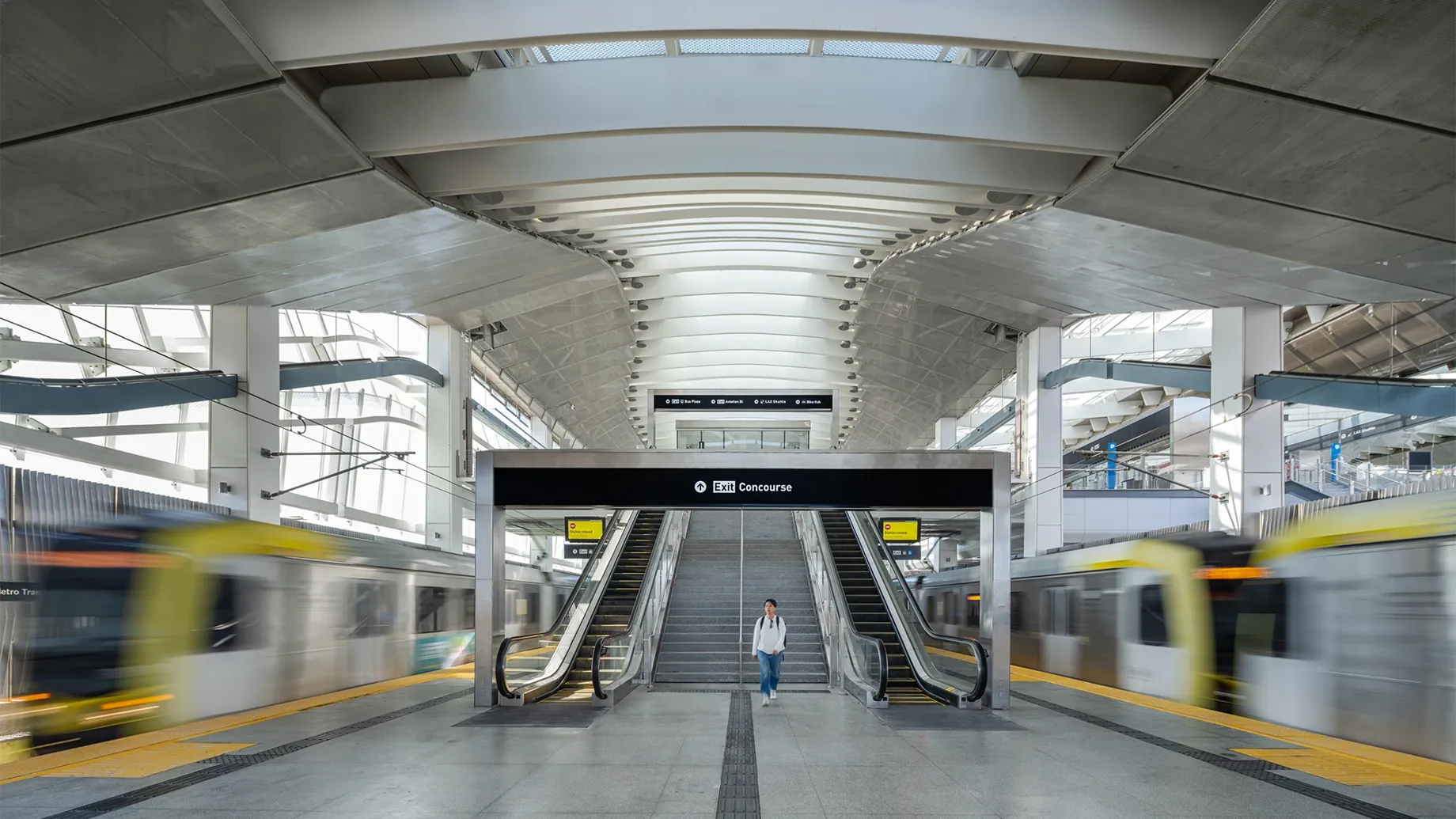
For decades, Los Angeles International Airport (LAX) lacked a direct connection to the region’s transit network. The LAX/Metro Transit Center, opened in 2025, has transformed the mobility landscape of Los Angeles for millions of residents and visitors.
The transit station provides a critical link between the airport and the Los Angeles County Metropolitan Transportation Authority (Metro) regional rail, bus lines, and bike lanes.
The station design was led by design architect Grimshaw, and Architect of Record and landscape architect Gruen, working with Arup. Arup led the structural design of the station and provided façade engineering, fire and life safety, fire protection, sustainability, acoustics and paging, lighting, security, ITC consulting, and pedestrian modeling.
By 2035, the station is projected to see nearly 46,000 daily riders across rail, bus, and an adjacent elevated automated people mover. The transit center will play a crucial role in alleviating traffic at LAX, one of the world’s busiest airports, and championing active, low-carbon mobility across Los Angeles. Beyond infrastructure, the project delivers real social impact, improving access for airport workers and nearby South LA communities. It’s a model for inclusive, sustainable, and community-driven transit.
Structural design that goes beyond code
The transit center is an architectural icon, with sweeping canopies, elegant skylights, and glazed screens. With its location in a high-seismic region, designing the landmark station posed an engineering challenge. The project team brought technical ingenuity and close collaboration to achieve an elegant structure that is also resilient and future ready.
The station has been designed to withstand both frequent tremors and the maximum considered earthquake, ensuring minimal downtime after a seismic event. Achieving this level of performance required going beyond standard building codes where Arup’s structural engineering team led a peer-reviewed, performance-based seismic design approach. Using non-linear analysis and performance based acceptance criteria, the design incorporates exposed steel columns, trusses, and long-span beams that provide the structure’s lateral resistance.
Spanning 1,100ft from north to south, the transit center features exposed steel that both create visual interest and provide structural support. Within the central Metro hub and light rail platform, 60-foot-tall canopy roofs soar over the elevated mezzanines. In the bus plaza, two 600-foot-long ribbon-like canopies anchor the north end of the site, rising to seamlessly integrate with the roof of the Metro hub. Structural stability comes from the combination of steel elements, including cantilever columns and a truss moment frame system. The result is an elegant, open station with striking architectural design enabled by advanced seismic engineering.
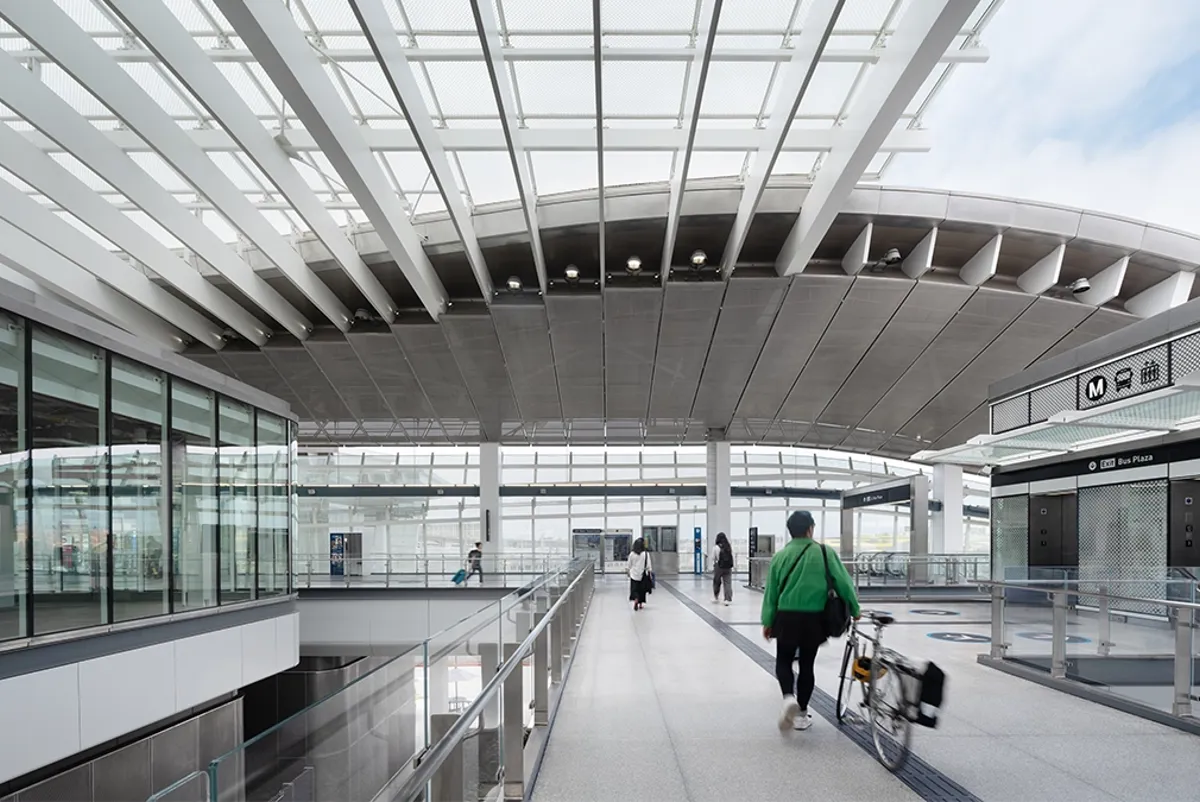
With its location in a high-seismic region, the transit center has been designed to withstand the maximum considered earthquake © Jason O'Rear
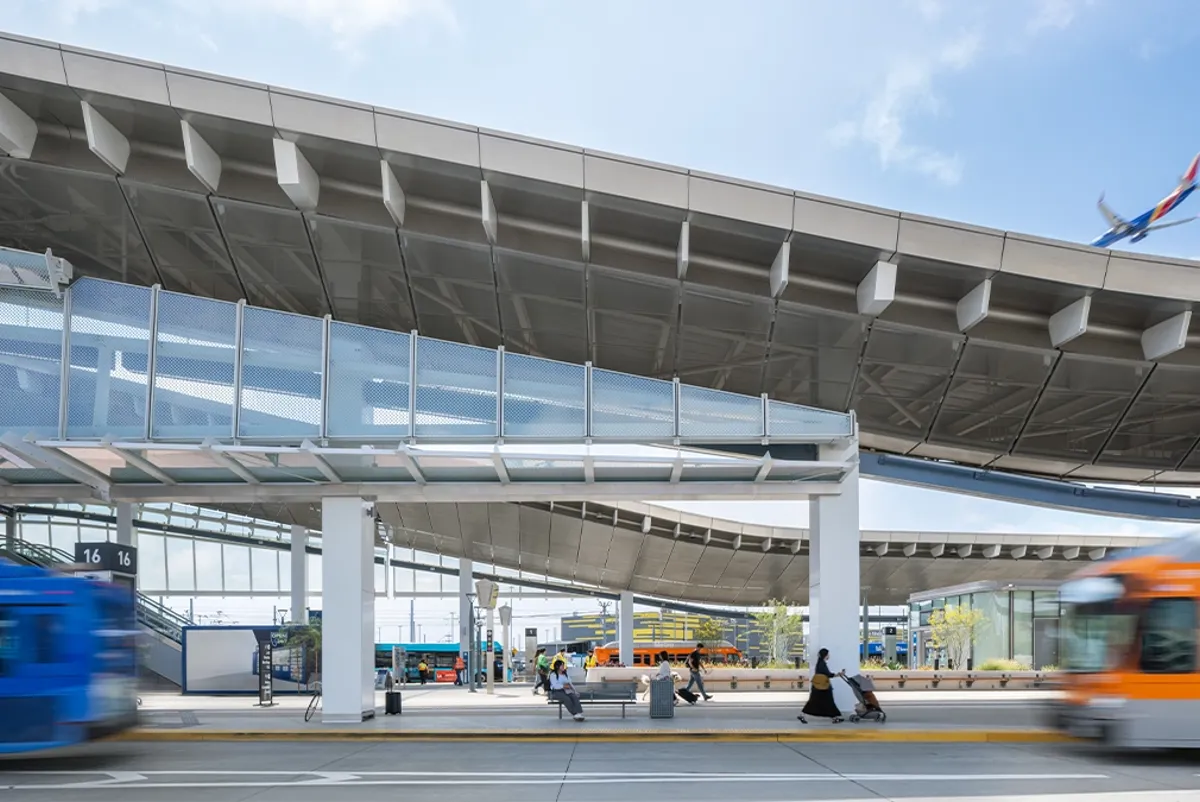
The transit center has transformed the mobility landscape of Los Angeles, providing a low-carbon alternative to private cars © Jason O'Rear
Supporting low-carbon mobility
A step change for urban mobility in Los Angeles, the new transit center connects LAX travelers to light rail, bus, and bike transit without the need for a private car. The station is expected to increase the ridership on Metro’s K Line by 40%, which would lead to significant avoided carbon emissions. The bike hub, connecting to protected bike lanes and Metro’s regional bicycle network, promotes active transport. Over time, the transit center will improve regional air quality and public health by promoting green, healthy travel.
Arup collaborated with Gruen and Grimshaw to incorporate a number of sustainable design features for the transit center. An on-site photovoltaic array generates half of the interior energy demand of the entire transit center. Electric bus chargers support Metro’s ongoing transition to an all-electric fleet. Taking advantage of the coastal climate, the open spaces include passive heating and cooling. Only 40% of the station is air-conditioned, which alongside daylighting, reduces overall energy demand. The project is targeting LEED Gold certification.
Safe, welcoming illumination
Lighting played an integral role in shaping user experience for the LAX/Metro Transit Center. The design supported wayfinding, ensured safety, and fostered a welcoming atmosphere while meeting the sustainability and maintenance demands of a high-traffic, day-to-night transit station.
The lighting strategy was carefully developed to address the needs of different transit modes, including vehicles, rail, bikes, and pedestrians. Arup’s design fosters a sense of safety and enables easy navigation through consistent visual cues and brightness hierarchies.
Arup’s lighting designers worked closely with the architects to accentuate the station’s form. The central component of the lighting design was the “tech bar” beam, which integrates speakers, security, and lighting. Creating this seamless, multi-functional design required close interdisciplinary collaboration. Working with architects, contractors, and manufacturers, the design team collaborated on a luminaire that transitioned smoothly between straight and curved beams, reinforcing the station’s fluid aesthetic and creating a bright, airy feel. The lighting controls system was programmed with an astronomical time clock to provide a seamless transition from a daylight experience to a safe and welcoming nighttime scene.
The undulating canopy, comprised of metal panels with varying angles, sizes, and distances, posed a challenge for mounting lights. To address the unique architecture, Arup designed a modular system of mounting techniques that served as a kit of parts for multiple scenarios across the project. The solution allowed for illumination that was lower cost and more construction efficient while still curating a welcoming atmosphere. Together, the effect is a line of recessed light that runs parallel to passenger movement, reinforcing circulation flow and providing illumination throughout walkways.
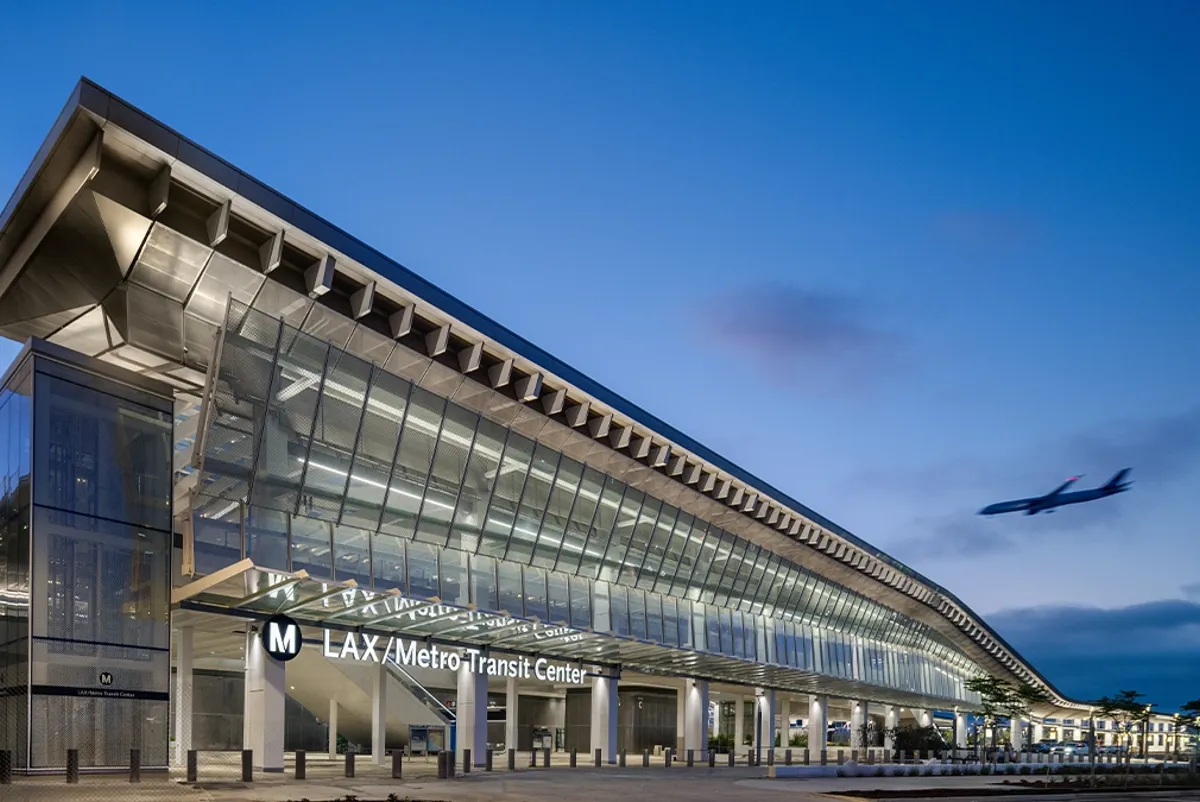
The transit station provides a critical link between the airport and LA Metro's regional rail, bus lines, and bike lanes © Jason O'Rear
Setting a new standard for Metro’s acoustic design
The LAX/Metro Transit Center is a partially open-air station with consistent sound from various modes of transit, including the noise from airplanes overhead. Arup’s acoustics experts supported the design of an intelligible public address system and maximized acoustic comfort for passengers.
Before this project, Metro’s design criteria only accounted for fully enclosed stations, where noise reverberates harshly. While designing the semi-enclosed LAX/Metro Transit Center, Arup supported Metro in updating their standard for acoustic design. Arup used modeling and code comparison to recommend solutions for upgraded loudspeakers and acoustic materials integrated into the architecture. Acoustic engineers relied on the Speech Transmission Index (STI), a metric that measures the clarity of speech through loudspeakers heard by passengers and the impact of the acoustic design.
A bright, airy station
Arup’s façade team provided integrated engineering for the hybrid indoor-outdoor transit space, balancing technical performance with architectural flair.
The transit station takes advantage of California’s coastal climate with shading canopies and natural ventilation. Prioritizing passenger experience, the façade design employs passive cooling strategies and high-performance materials to create a comfortable atmosphere. Glazing was carefully selected to enhance thermal comfort for passengers while maintaining the airy, open feel of the station.
Grimshaw / Metro
Awards
-
American Council of Engineering Companies (ACEC) California, 2026
Golden State Award
Projects
Explore more rail projects:

Enabling historic investment to achieve a more modern, reliable, and connected Northeast Corridor rail network
CONNECT NEC Program, USA

A state-of-the-art 19km tramway network that will serve as the backbone of mobility in the Québec region
TramCité, Canada

Owner’s Engineer for Canada’s transformational Alto high-speed rail network
Alto High-Speed Rail, Canada

Creating two iconic stations as part of a major line extension
Toronto-York Spadina Subway Extension, Canada
Get in touch with us
If you'd like to speak to one of our rail experts about any of the issues raised on this page or a potential collaboration then please get in touch by completing the form.
